The Rising Trend of Novel ADCs
Novel antibody-drug conjugates (ADCs) are emerging as one of the fastest-growing areas of ADC innovation. These next-generation modalities include antibody-oligonucleotide conjugates(AOCs), dual-payload ADCs (dpADCs), bispecific ADCs, degrader antibody conjugates(DACs), antibody fragment-drug conjugates, and others.
According to the Beacon database, only four novel ADC programs were reported in the first half of 2021. By the end of 2025, that number had increased to nearly 600.
Advantages and Rapid Growth of dpADCs
Among these modalities, dual-payload ADCs have attracted particular attention because they offer the potential to overcome tumor heterogeneity and drug resistance by combining two complementary payloads within a single ADC. This strategy may enhance anti-tumor efficacy, broaden therapeutic activity, and ultimately improve the therapeutic index compared with conventional single-payload ADCs.
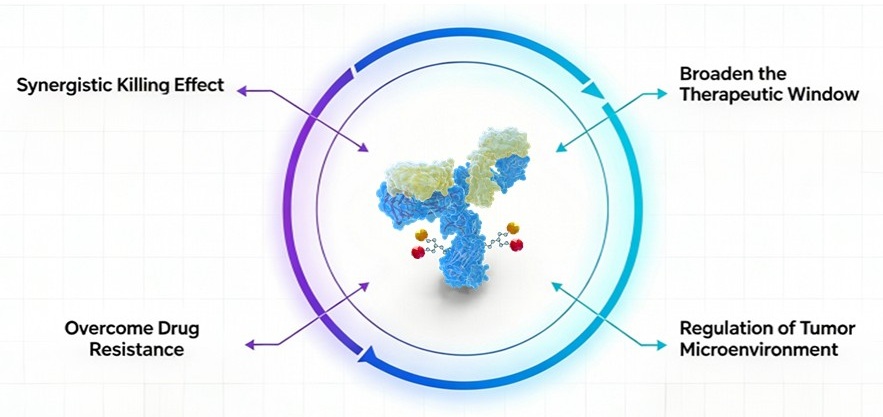
Key advantages of dpADCs
Clinical development of dpADCs is also accelerating. At the 2025 AACR Annual Meeting, only one dpADC had entered clinical development. By July 2026, at least ten dpADCs had advanced into clinical trials. In addition to the ten clinical-stage programs, more than 100 dpADCs are currently in preclinical development.
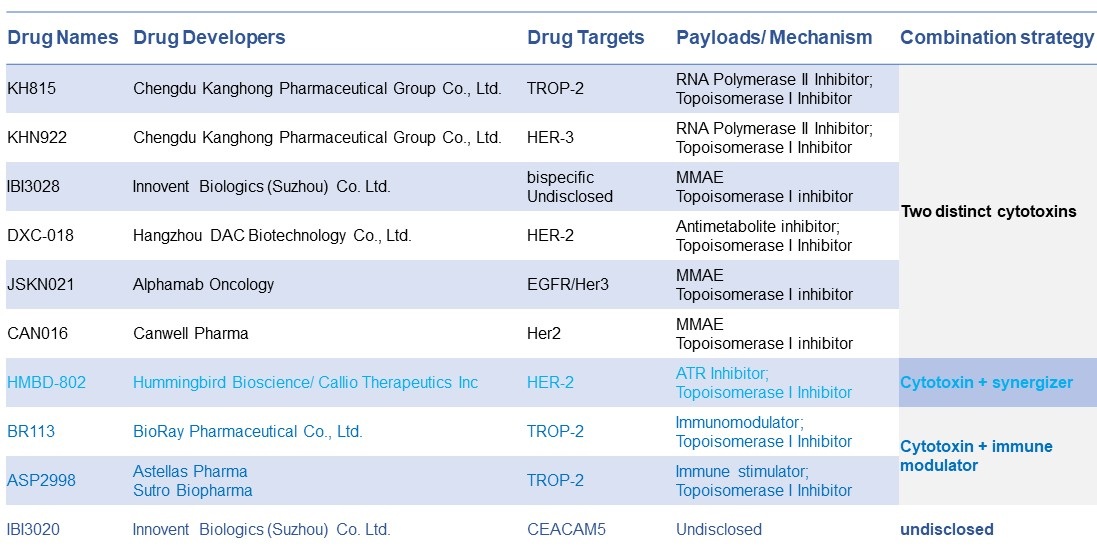
Ten+ dpADCs in Clinical Stages
Classification of dpADCs by Payload Combination Design
Based on payload combination strategies, dpADCs can generally be classified into three categories:
- Two cytotoxic payloads with distinct mechanisms of action (MOAs), such as Top1 inhibitor + RNAi or Top1 inhibitor + MMAE.
- A cytotoxic payload combined with a synergizer, where the second payload enhances the activity of the primary payload, such as Top1 inhibitor + DDR inhibitor (DDRi).
- A cytotoxic payload combined with an immune modulator, such as Top1 inhibitor + STING agonist.
Dual Conjugation Strategies
Two major approaches are commonly used to construct dual-payload ADCs as shown in the figure below:
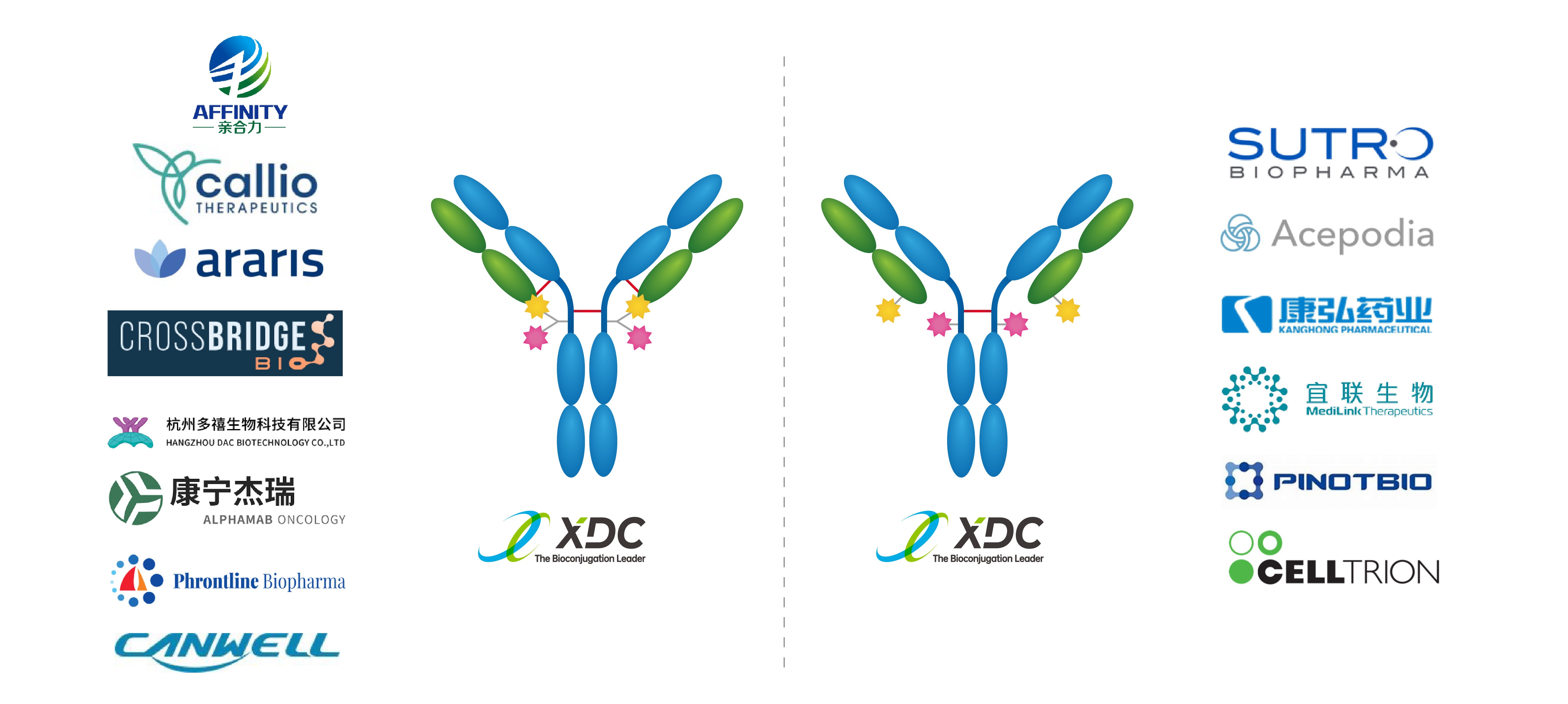
Snapshot of companies utilizing branched linkers vs dual-site conjugation
- Branched linker approach, where one conjugation site carries two or more payload molecules.
- Dual-site approach, where different payloads are conjugated to separate conjugation sites on the antibody.
WuXi XDC has established capabilities to support both strategies.
Dual-site approach
For the dual-site approach, multiple conjugation chemistries are typically required. WuXi XDC can leverage the proprietary WuXiDARx® platform followed by interchain cysteine conjugation to generate homogeneous, site-specific dual-payload ADCs with formats including 2+6, 4+4, and 2+4, while using only a single conjugation chemistry.
Interchain cysteines are widely used as conjugation handles for ADCs. However, conventional cysteine conjugation is generally regarded as a random conjugation approach. WuXi XDC has developed proprietary reduction and reoxidation procedures that enable selective reduction of interchain cysteines for site-specific conjugation. This proprietary technology, the WuXiDARx® conjugation platform, is the only site-specific conjugation technology based on native interchain cysteines that does not require antibody engineering.
To generate dpADCs, the WuXiDAR2 process is first used to produce a site-specific DAR2 ADC carrying the first payload, followed by conjugation of the second payload to the remaining interchain cysteines to generate a 2+6 dpADC. Similarly, WuXiDAR4 enables generation of 4+4 dpADCs, while combining WuXiDAR4 with thio-rebridging technology enables 2+4 constructs. This approach relies solely on native interchain cysteines and a single conjugation chemistry, eliminating the need for antibody engineering or enzymatic modification while simplifying CMC development and improving manufacturing efficiency.
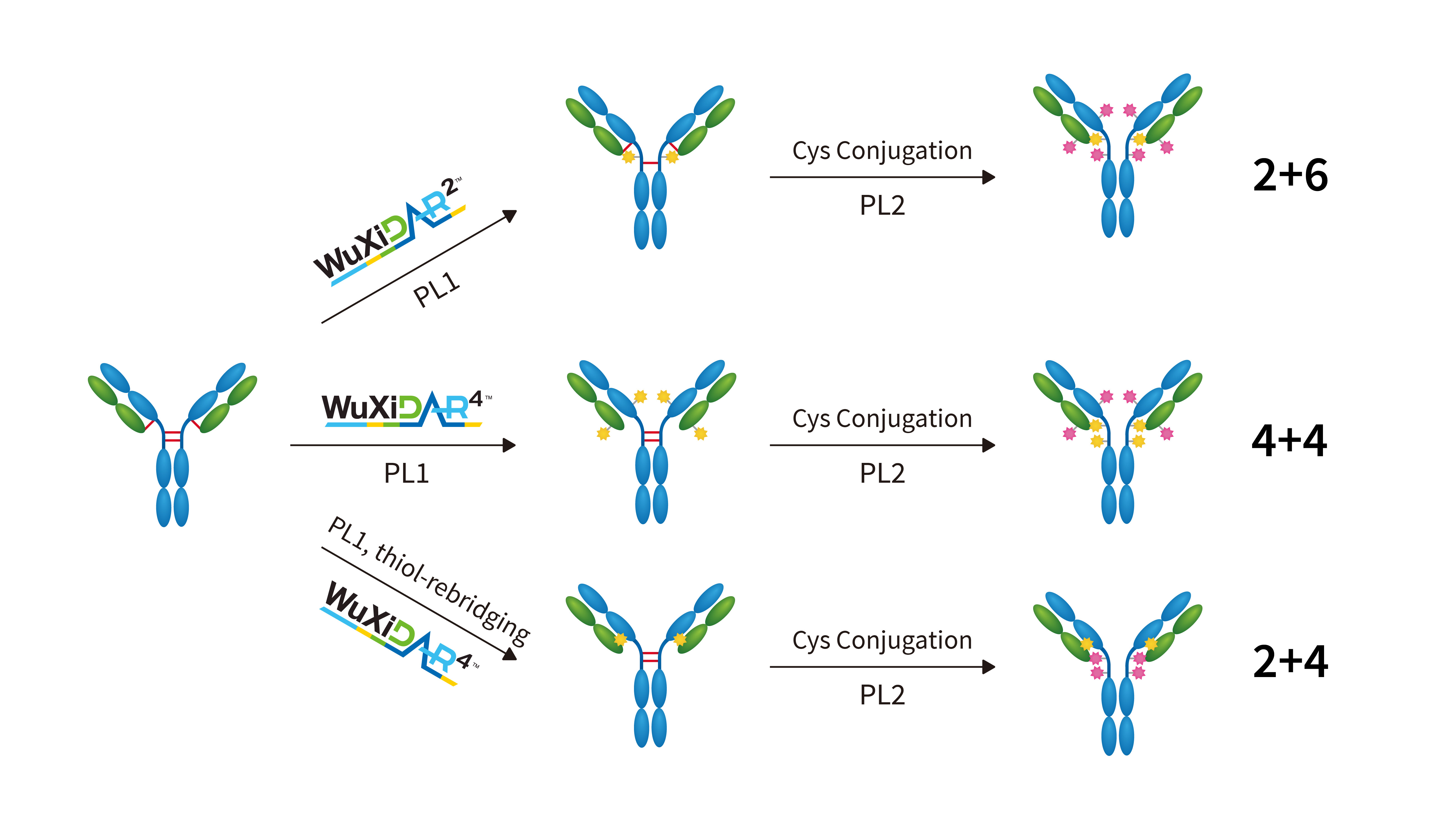
Dual-site conjugation approach in WuXi XDC through properiatery WuXiDARx technology
In addition to sequential WuXiDARx followed by interchain cysteine conjugation, WuXi XDC can combine enzyme-mediated conjugation with WuXiDARx to generate 2+2, 2+4, and 2+6 dual-payload ADCs.
Other dual-conjugation strategies are also available, including:
- Enzyme-mediated conjugation combined with random cysteine conjugation (e.g., 2+4 and 2+8);
- Engineered cysteine combined with interchain cysteine conjugation (e.g., 2+8);
- Fully cysteine-based dual conjugation approaches.
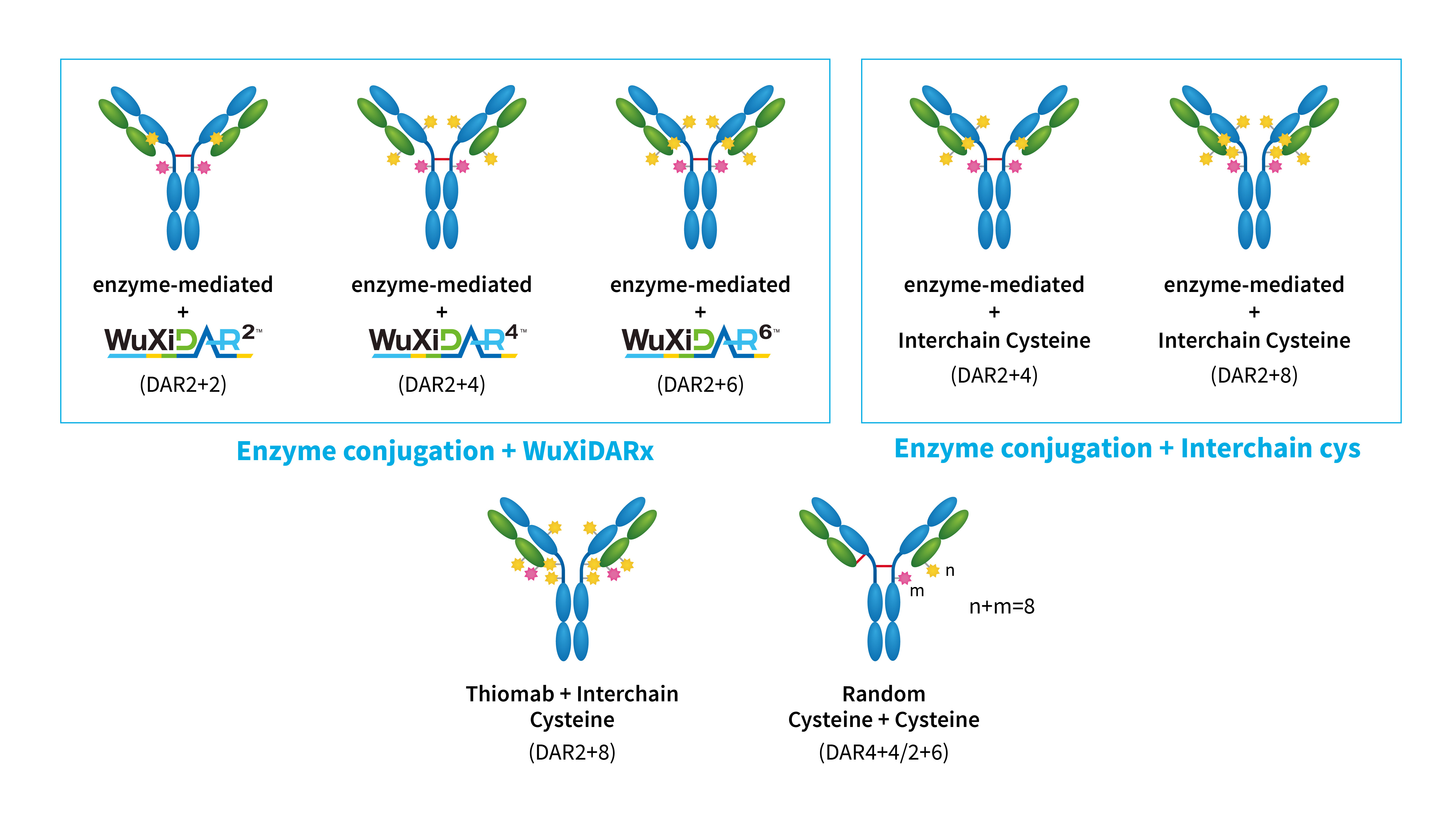
Other extensive dual-site conjugation approaches in WuXi XDC
Branched linker strategy
For the branched linker strategy, WuXi XDC also has extensive experience. By controlling the branching architecture of the payload linker, the drug-to-antibody ratio (DAR) and payload ratio can be precisely tuned, enabling formats such as 1:1, 2:1, and 2:2, as illustrated below.
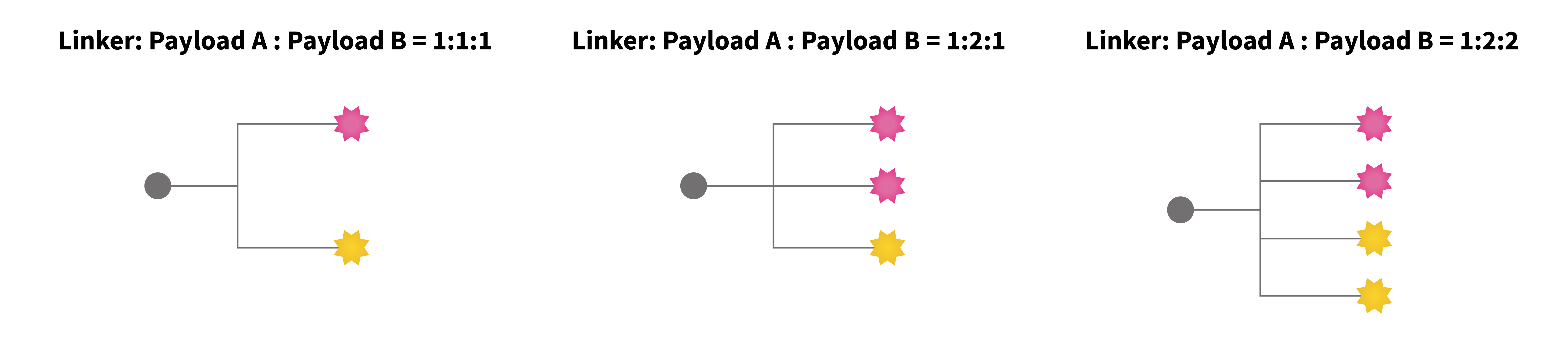
Extensive branched approaches in WuXi XDC
Challenges in dpADC Discovery
Despite their significant therapeutic potential, the discovery and development of dpADCs remain challenging. Compared with conventional ADCs, biological evaluation is also more complex. Cell lines must be selected to reflect the mechanisms of action of both payloads, while pharmacology studies frequently require drug-resistant tumor models or syngeneic models to demonstrate the advantages of the dual-payload strategy. In addition, the increased molecular complexity places greater demands on analytical characterization and developability assessment.
For organizations conducting discovery in-house, these activities require substantial cross-functional expertise and investment. Alternatively, outsourcing to multiple CROs often creates project management challenges, increases technology transfer activities, and may introduce delays between different stages of development. As a result, the discovery phase for dpADCs frequently exceeds 18 months.
Integrated Discovery Services
WuXi XDC’s integrated discovery platform is designed to streamline ADC discovery. For dpADCs, an integrated discovery approach becomes even more important than for conventional single-payload ADCs, as payload-linker synthesis, dual-payload conjugation, purification, analytical characterization, and developability assessment are significantly more complex and highly interconnected.
Our payload-linker discovery team has extensive expertise across a broad range of payload and linker classes, including widely used cytotoxic payloads such as topoisomerase inhibitors and tubulin inhibitors, as well as non-cytotoxic payloads including immune agonists and DDR inhibitors. This broad experience enables efficient evaluation and selection of optimal payload combinations for dual-payload ADC discovery.
WuXi XDC has also built extensive practical experience in dual-payload ADC discovery across a wide range of programs. To date, our team has successfully generated more than 250 dual-payload ADCs spanning diverse antibody formats, payload combinations, linker designs, and conjugation strategies. This accumulated experience provides valuable insights into conjugation optimization, purification, analytical characterization, and developability assessment, enabling efficient evaluation of different dpADC designs and helping clients accelerate candidate selection with reduced technical risk.
With expertise spanning payload-linker synthesis, multiple dual-conjugation technologies, analytical characterization, developability assessment, and biological evaluation, WuXi XDC provides an integrated platform to support clients throughout the dpADC discovery process. By combining broad technical capabilities with flexible conjugation strategies, WuXi XDC helps enable efficient development of high-quality dual-payload ADC candidates, allowing clients to focus on advancing the most promising therapies toward the clinic.
Browse our blog library → Expert Blog